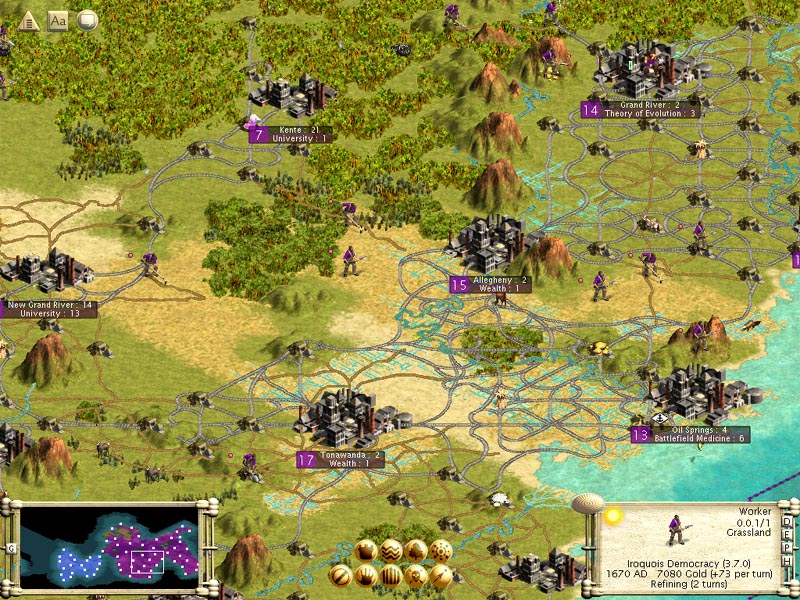
As a civ player I would love to the the mechanics mentions where you could overfish, overfarm, etc and mines and other production improvements had negative impacts on through pollution & other risks (eg offshore oil platform spills, etc). There could be techs & policies to mitagate these issues, but investing/adopting in them would be a trade-off on production & wealth.
I enjoy this vein of thought. It would feel more satisfying if escalation in difficulty (e.g. "Deity" level) added mechanical complexity and trade offs rather than just giving opponents artificial advantages.
- Tile focus can damage the output of surrounding tiles
- Mines might temporarily/permanently reduce nearby food production or appeal
- Longterm tile focus can outright destroy the resource
- Overfishing, Strip mining, Soil depletion
- Bring back or re-emphasize some of the old mechanics
    - Population explosions also increase civil unrest

    - Corruption quickly eats away economic output
- Opponent choices can cause cumulative/permanent damage to your cities if they are nearby, downstream, or downwind.
If you want to add a 'modern' political issue you could add a dynamic where city growth results in a backlash from "original" city participants who push for laws/policies to keep the city the 'same', increasing real estate prices, zoning issues, subsequent gentrification as no new internal growth pushes the wealthy out into low income housing areas, lack of low income housing as it can't keep up with gentrification (or development of low income housing lacks profitability due to laws like rent control or other well intentioned laws), and generally hampers growth and increases conflict/unhappiness within the cities.
That's already modeled, both in the exponentially increasing food requirements for growth (growing from 10 to 11 is much harder than 1 to 2, for nearly the same benefit), as well as the housing cap and amenities mechanics in the latest iteration of the game.
> As a civ player I would love to the the mechanics mentions where you could overfish, overfarm
This is kind of represented as harvesting a bonus resource. Your workers can be spent chopping down forests, scooping up all the fish, deer or bannanas for a short term gain. Some of the AI are randomly assigned an environmentalist outlook that will sour relationships if you do harvest a tile.
> etc and mines and other production improvements had negative impacts on through pollution & other risks (eg offshore oil platform spills, etc).
Oil spills feel a little too random. In Civ 6, this mechanic would likely be implemented as water and appeal (tourism) reduction. Mines and quarries already have this implemented, each one reduces the appeal of its six adjacent by 2. I don't think oil rigs have any penalties.
> There could be techs & policies to mitigate these issues, but investing/adopting in them would be a trade-off on production & wealth.
Generally speaking, techs aren't optional. There are very few terminal techs, and that seems pretty intentional. As a policy card tied to the Conservation civic it might work. But there's already a tradeoff being made by having the improvements in the first place.
I remember in the first Civ that there was a notion of pollution that started kicking in once you had built factories. The only way to clean it up was to dedicated Settler units to go around and clean it up.
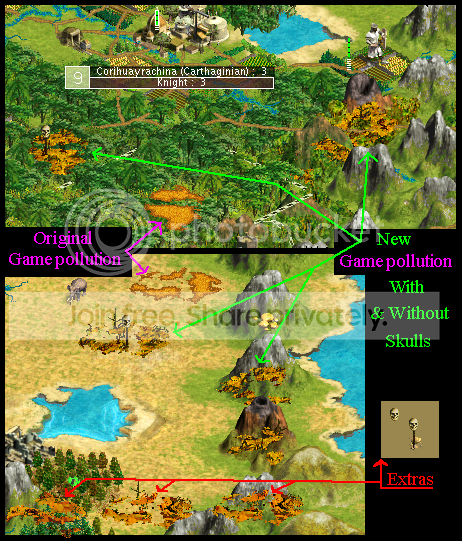
I remember hating the orange patches that came once pollution kicked in while playing Civ3. My younger self would get really, truly pissed at the fact that I, apparently, had failed to have enough foresight as to not damage my precariously acquired land.
Oh, and the orange patches, the god damned orange patches. This thread brought back some really funny memories. It's almost as if I can still feel my frustration at that time.
For those wondering what the orange patches looked like in an older version:
And of course a quick search had me in laughter for a while:
"An option to turn off the %$!&! pollution"
"This has been mentioned before, but I'm bringing it up again anyway. In Civ2 the interface worked much quicker, and the city worker wasn't taken off the tile. Dump some engineers on it and bam! - problem solved. In Civ3 it goes something like this: spend a bunch of time hunting down some free workers on the slower map screen. Figure out how many it takes to clean up the square, move them there, and order them one by one to clean it up. Then, open your city screen. Put the laborer back on the tile (unless another city has taken over the tile at the start of the next turn - then it gets even more complicated). If you're using your workers on automatic (clean up pollution only) you still have to look at every city every turn, and if you have alot of pollution that turn, they may not clean it up in the order you like, causing the loss of shields, perhaps even delaying the production of something important for a turn. This is why I always have some free workers to pile on by hand anyway, even though it takes longer."
And finally, a future techy enters the stage:
"I agree that it becomes tiresome to chase pollution.
Edited my game so that pollution takes less workers to clean up. :mischief:"