I think there's a weird tendency in modern internet culture to take long-established things and decry them as myths, where the whole debunking consists of bad faith engagement with a straw man argument not attributed to anybody. And sometimes even the debunking itself is just a more nuanced restatement of the idea supposedly being debunked, offering to substitute it for the 'simplistic' view that someone, somewhere, supposedly believes.
And I don't think the thesis put forward by the Civilization franchise is necessarily wrong, however dreary. As with anything, it depends on the level at which you engage with it, and how much good faith you apply and which things you choose to emphasize or not emphasize. Economic strength and accumulation of resources and sheer population do have a lot to do with who dominates. But maybe it takes other stuff, too. Maybe playing a game doesn't mean you're ignoring it, and "correcting" the thesis of the game doesn't mean we're due for an overthrow of a grand cultural dogma.
>Economic strength and accumulation of resources and sheer population do have a lot to do with who dominates. But maybe it takes other stuff, too.
That may be but it's got nothing to do with the article which is talking about Civilization--and games in general-- presenting monotonic, consequence free growth as the only state of being until the "A Winner Is You" screen (the dangerous myth)
Which as a side effect leads to grind-y end games where you have dominated everyone but still need to put in another hour of grind to actually finish them off or otherwise end the game (the bad game design).
Huh? The stuff I'm talking about might as well as have been a verbatim quote from the article itself.
>Through the Civilization lens, raw economic strength is success. Population is power.
What's the difference between that and my statement, "Economic strength and accumulation of resources and sheer population do have a lot to do with who dominates." ?
One is that the game Civilization advances a supposedly dangerous narrative about the myth of progress. Another is that, in gameplay terms, this infinite expansion and growth leads to a grindy end game.
You seem to be saying that the latter is the real point, and that by addressing the former I'm missing the point. I think the former is the more important point and I feel like I did a reasonably good job of being responsive to it, and I feel that cryptic comments telling me I'm missing the point are unfairly dismissive.
You wabbled about click bait and then took issue with how dominance is achieved, meanwhile literally every other sentence in the article is about perpetual growth, how perpetual growth a dangerous myth, how other games deal with it or how it's bad game design.
You didn't address the myth of progress at all, which regardless of it's merits from a grand historical point of view certainly doesn't apply to individual nations which rise and fall all the time. You certainly didn't present any arguments against the idea that unthinking growth sometimes actually has consequences which Civilization games have actively been removing.
All you said economic power and resource accumulation probably leads to dominance. But it's not dominance the article takes issue with, it's that dominance is represented only by growth which is why one sentence after your quote: "Only growth matters"
Civilization does not actually portray inevitable perpetual growth. It's quite possible for your advanced civilization to be conquered by barbarians (actual barbarians or a less-advanced civilization; it doesn't really matter which), and when that happens, technology is lost.
As a matter of practice, this doesn't happen much because it isn't fun, but it's well within the game's view of what can theoretically occur.
> One is that the game Civilization advances a supposedly dangerous narrative about the myth of progress
Agreed, the author is not only making the point that it's a dynamic of modern games (to our detriment) but a reflection of a popular 'myth' held within our post-industrial revolution societies.
>> We live in a brief historical blip where abundant resources and a few centuries of astounding progress have allowed many to believe that the good times will roll forever.
Which is strange worldview considering "The Decline and Fall of the Roman Empire" is one of the most popular and well known books in history, and a widely debated topic in academia. Always with undertones comparing to the unique growth of the modern western society.
There has always been plenty of anxiety about growth throughout our recent history...
I really like the approach taken by Factorio, which is that you play as a villain. A genocidal, colonialist, polluting, industrious, and perhaps unconscious villain. The game doesn't state this, but I believe most players basically agree it's the case.
Is that their actual intent? I always had the impression the game is mostly not caring about the consequences at all and simply wants to be a toy for people engaging in fantasies of complex automated systems.
(Otherwise those people might find other outlets for their fantasies... like designing horribly overengeneered software architectures...)
I agree you could make an awesome game about this by pretending to be a purely utilitarian engeneering puzzle and later showing you the actual consequences of your actions. But I wasn't aware that was their actual strategy. If it was, hats off!
I explain this to myself using a simple maxim: "Any premise that can attract eyeballs will eventually appear as an article on an ad-revenue-driven website".
The points are valid but let's step back and remember that this is a game. When someone plays Call of Duty, there is a suspension of disbelief that allows the player to ignore the horrors of war (and zombie nazis and whatever else they're doing these days). When I play Civ, I suspend my disbelief when Ghandi tells me that nukes are the way of the future in 200BC and Teddy Roosevelt declares war on Cleopatra.
Civ is not a perfect reflection of history, society, or civilization, let alone an idealistic society or civilization. And in truth, that's what makes it fun. Pinning the fate of our "IRL" civilization on a game because it perpetuates the myth of perpetual growth is a bit ridiculous. The perils of capitalism are not going to be defeated by changing the mechanics of a Sid Meyers game.
If we want to talk about the harm video games bring about, let's talk about loot crates and microtransactions in F2P games.
There's nothing special about a game compared to any other form of media, or any form of fictional storytelling which make them immune to having an influence. You have to suspend disbelief in any novel, nevertheless no matter how outlandish the material it always communicates some ideas about the way the world works. I'm actually really looking forward to people giving up on the implicit idea that video games are just fancies or toys, because it's at that point that video games which set out to communicate interesting or unsettling ideas or perspectives will become mainstream.
Are you saying it's irresponsible, then, to publish a novel whose plot revolves around the success of perpetual growth (or success of a civilization embracing perpetual growth)? Influential or not, we shouldn't censor media that we find enjoyable because its real world counterpart is destructive.
Critizing a creative work is not censorship. Using the authority of the state to repress a creative work is censorship. I am free to, and in some sense ethically obligated to criticize the ideological implications of creative work.
People have a right to free expression, they don’t have a right to have thst expression amplified by third parties. I’ve noticed that when an emotive word is overused, often with a new word in front of it, it’s bullshit. “Mob censorship” “white genocide” and so on for some glaring examples, might as well have the first words replaced by “Not really.”
Co-opting words with strong emotional valence for the sake of an appeal to emotion is petty, and speaks to the weakness of the underlying argument.
Most dictionaries have a broader definition. Here's the ACLU:
> Censorship, the suppression of words, images, or ideas that are "offensive," happens whenever some people succeed in imposing their personal political or moral values on others. Censorship can be carried out by the government as well as private pressure groups.
> Are you saying it's irresponsible, then, to publish a novel whose plot revolves around the success of perpetual growth (or success of a civilization embracing perpetual growth)? Influential or not, we shouldn't censor media...
Would you respond to a critical book review by saying "we should not censor media"? Criticism and censorship are two vastly different concepts, you should not conflate the two.
Fair, but GP's argument transfers perfectly to non-interactive media. They may have good points, but you still have to be careful trying to apply their ideas to the real world.
Some of them are. There is certainly an endgame challenge in 4x games, but real world civilizations don’t really fall at the pace needed for the comparison to make sense.
Rome is still the center or one of the largest world religions today for instance.
I didn't get the totally preachy vibe from the article that you may have.
In all honesty, I thought he was going for slight moralization but mostly just wishing there were realistic civilization-type games that have a complex endgame and are not based on an endless growth model. I'd welcome some of his propositions-- they seem more challenging and consequently more engaging and fun.
I remember listening to a talk from Sid Meier and at some point he explains how they tried to implement a rise-and-fall system in the original Civ. It didn't go very well. Playtesters hated it.
When the first fall came, people just quit and start again, thinking that they did something wrong. When they were told it was intended and they had to fall to rise again, they just didn't like it at all.
I can see a niche for a hardcore strategy game where rise and fall is part of the game loop, but given the current estate of affairs it would be just that, a niche game.
Smallworld is a board game with a rise and fall game loop. It works very well in the game because your "civilization" is very obviously growth limited, and you don't spend much time building up a civilization so seeing it decline is not very painful.
This sort of sounds like the Europa Universalis series, where history affects the various countries you can play. There's nothing stopping you from trying to reverse the decline of Byzantium upon the onslaught of the Ottomans, but the deck is certainly stacked against you...
EU IV's "failure" states are a lot more interesting than those in Civilization. You can take a severe beating, lose a lot of territory, and recover it later.
This is because holding territory is a lot harder, and integrating captured territory is more expensive. You can't snowball as quickly, and short-term setbacks can be reversed by planning carefully.
Civ's new expansion does try and fix some of this, but it's not as nuanced as in EU IV. City-flipping is a thing again, but the mechanics are pretty cartoony.
And just this phenomenon, of pandering to customers' desires, and giving them the fake news they want, is where we get the pejorative word "stereotype." Stereotypes were 19th century 3-D photographs. At first, these showed realistic foreign scenes but it soon became apparent that the audience wanted to see (and would only pay for) truly exotic costumes on those foreigners, and exotic customs, whether this had much to do with reality or not.
"Writers and people who had command of words were respected and feared as people who manipulated magic.
In latter times I think that artists and writers have allowed themselves to be sold down the river. They have accepted the prevailing belief that art and writing are merely forms of entertainment. They’re not seen as transformative forces that can change a human being, that can change a society. They are seen as simple entertainment—things with which we can fill twenty minutes, half an hour, while we’re waiting to die.
It is not the job of artists to give the audience what the audience want. If the audience knew what they needed, then they wouldn’t be the audience; they would be the artists. It is the job of artists to give the audience what they need."
> If the audience knew what they needed, then they wouldn’t be the audience; they would be the artists.
Games know what they want. They complain very loudly, when they get something different than what they wanted/expected.
Of course game developers and publishers again want slightly (or completely, I'm looking at you Electronic Arts) things. Developers want that artistic meaning, publishers want a lot of safe money, while gamers want to enjoy the game, they want the flow [0], the feeling of conquering a hard but not impossible challenge.
No, a "stereotype" is a printing plate, used to print many copies of the same page; it has meant that since 20 to 40 years before the invention of photography.
The viewers were called various names Stereopticon, Stereoscope. But what you viewed, the cards with the two images were referred to as a stereotypes, after their printing process, I would suppose. The devices were extremely popular. Neither of your sources that address etymology address the etymology of the word in reference to prejudice. So they can hardly be held to contradict.
On the contrary, all three of the pages I linked about the etymology of "stereotype" explicitly address the etymology of the word with reference to prejudice. I am at a loss as to why you would say they did not.
Also, the cards with the two images were not referred to as stereotypes, and they were not printed from stereotypes, because it was not possible to print photographs from stereotypes until the invention of halftoning, which entered commercial use in 1873/ It is wholly implausible that this would result in changing the popular name of stereoscopic images, some 30 years after the invention of the stereoscope and 10 years after they became popular. Even after the invention of halftoning, stereoscopic images were almost invariably printed instead using photographic processes, which do not use stereotypes. Even in the late 20th century, View-Master discs were made using photographic film, not ink.
There is no attested history of using the word "stereotype" to refer to stereoscopic images.
Quite false. They have nothing about the origin (etymology) re prejudice, just the time period so hardly contradict, just as I said. Fer instance, "Meaning "preconceived and oversimplified notion of characteristics typical of a person or group" is recorded from 1922." That fits my origin, and offers nothing else. I am at a loss as to why you can't acknowledge that.
Extraordinary claims need extraordinary evidence though. Until now nobody brought any evidence for the claim, so we should disregard it as fiction until we have that evidence.
Seriously? The game, which is already quite long to play, should be made 8 times as long just to make it more realistic in one narrow dimension. And players are morally obligated to appreciate it?
This article is an interesting pair to Jimmy Maher's "The Game of Everything, Part 2: Playing Civilization" [1] published just two days ago.
He makes the same point that the original Civilization was designed around the assumption of a relentless march of growth and progress that will ultimately benefit all mankind. This is encoded in the game's winning conditions: "You win a game of Civilization in either of two ways: by eliminating all rival civilizations or by surviving until the colonization of space begins."
"Bruce Shelley, who authored the manual, is thus explicitly discouraging the player from approaching Civilization as a zero-sum game: you win simply 'by being in existence when colonists reach Alpha Centauri.' This doesn’t mean that all or most players played under that assumption — a topic I’ll return to momentarily — but it’s nevertheless kind of an amazing statement to find in a game like this one, implying as it does that civilization writ large truly is a global, cooperative project. There’s an idealism lurking within Civilization, this game that plays not just with economics and war but with the grandest achievements of humanity, that’s missing in the likes of Master of Orion. It’s notable that, while the history of gaming is littered with hundreds of galaxy-spanning 4X space operas, vanishingly few games beyond Civilization‘s own sequels have attempted to replicate its model of grand strategy."
> "You win a game of Civilization in either of two ways: by eliminating all rival civilizations or by surviving until the colonization of space begins."
This isn't accurate at all. To win by colonizing space, it has to be you who colonizes space. If all you do is survive until somebody else does it, you lose.
In the expansions of Civ 3 (or 4?) in the late game you can lose tiles to effects of climate change and desertification. Though it was never a huge issue for my cities, a little production lost here, a little food there. I'm wondering why they took that out and what other set-backs they can add to Civ to prevent this perpetual growth gameplay. The article touches on the challenges of this, that with these balances the game still has to be fun. Civ 5 balanced (some might say over-balanced) perpetual expansion of civilizations by making new cities a pretty heavy resource sink until they were of a certain size. I'm not as big of a fan of that iteration because of that mechanic.
Civ II did as well, climate changes, through pollution and nuclear fallout, with enough global effect to use it as a strategy against more modernised but smaller rivals.
Such grim game progression was made all the more poignant by the space race game mechanic, where you could technically still "win" by sending a ship with settlers to a different star system which translated in many games to: "We're all doomed, but you were the first to avert complete extinction of the species. You Win!"
AFAIK it might have felt like unfairly penalties to the player. Sid Meier has discussed in an old interview the prototyping rise and fall of civilizations in the game. He concluded that it was not fun for someone to see the civ they built over the course of hours being taken from them.
I agree. As a person who has not played Stellaris but is aware of its excellent reputation, I got to the part of the article where it said Stellaris breaks up it's late game bloat, and was expecting the second half of that sentence to be very different. I thought it would be something about abstracting away the tedious low level details, and shifting toward supermassive macro scale problems, maybe going up a higher level like Spore, but in some salient strategic sense that fits the feel of Stellaris. I was disappointed to learn but the actual solution was just random punishments.
It's not really random punishment, it's challenges. eg, if you use certain dangerous technologies extensively (eg, strong AI, subspace drives) then a strong late-game enemy may appear at an unpredictable time (eg, rampaging AI bent on killing all races, rampaging fleets from another dimension).
I think this actually works well for Stellaris, because of the vassalization dynamics. In most 4X games, if you get defeated then you're dead and may as well quit. In Stellaris you can get defeated, become a vassal of another nation, and later break out to defeat your former masters. Having a powerful late-game enemy appear makes that sort of shakeup much more likely, as the smaller/vassalized empires may be able to pick off systems from the more powerful, but weakened or distracted, empires.
They're not really punishments, but difficult crisises that the player must overcome.
For example, two ancient powerful but inactive empires might become active and start a war. This allows the player to align with either one of the powers, or form an independent coalition with a chance to become the new "leader" of the galaxy. These events throw existing borders up relations up in the air, thus effectively making the game interesting again right as its becoming stale.
"not fun for someone to see the civ they built over the course of hours being taken from them."
Depends on the definition of "fun". A DwarfFortress-like definition might say "fun" is desperately trying to prevent or simply deal with things falling apart.
He’d be right. That’s one of the reasons I dislike the standard browser-based civ-inspired games such as Travian.
Not to say there is no was around that — when I last did game development I had an idea, but I don’t want to risk breaking my NDA by saying what, only that a potential solution might exist.
Similarly they removed the Civ 4 culture flipping in Civ 5. And, way back, the "militia defeats battleship" after Civ 1. Unpredictable minor penalties that increase the micromanagement burden aren't especially fun.
I think many commenters are missing the most important bit of this article. The author says, "There is a historical context for this modern myth of perpetual growth. It emerged from the Industrial Revolution ... Many of us act as if we believe this will continue forever, even to the stars themselves." The implication is that such growth won't continue forever, and we won't reach the stars. It's a sentiment that I happen to agree with, but the author takes it as something of a given, and spends the article talking about how these games reinforce false assumptions, assumptions which many people don't even think about. That's the real point here.
As a civ player I would love to the the mechanics mentions where you could overfish, overfarm, etc and mines and other production improvements had negative impacts on through pollution & other risks (eg offshore oil platform spills, etc). There could be techs & policies to mitagate these issues, but investing/adopting in them would be a trade-off on production & wealth.
I enjoy this vein of thought. It would feel more satisfying if escalation in difficulty (e.g. "Deity" level) added mechanical complexity and trade offs rather than just giving opponents artificial advantages.
- Tile focus can damage the output of surrounding tiles
- Mines might temporarily/permanently reduce nearby food production or appeal
- Longterm tile focus can outright destroy the resource
- Overfishing, Strip mining, Soil depletion
- Bring back or re-emphasize some of the old mechanics
    - Population explosions also increase civil unrest

    - Corruption quickly eats away economic output
- Opponent choices can cause cumulative/permanent damage to your cities if they are nearby, downstream, or downwind.
If you want to add a 'modern' political issue you could add a dynamic where city growth results in a backlash from "original" city participants who push for laws/policies to keep the city the 'same', increasing real estate prices, zoning issues, subsequent gentrification as no new internal growth pushes the wealthy out into low income housing areas, lack of low income housing as it can't keep up with gentrification (or development of low income housing lacks profitability due to laws like rent control or other well intentioned laws), and generally hampers growth and increases conflict/unhappiness within the cities.
That's already modeled, both in the exponentially increasing food requirements for growth (growing from 10 to 11 is much harder than 1 to 2, for nearly the same benefit), as well as the housing cap and amenities mechanics in the latest iteration of the game.
> As a civ player I would love to the the mechanics mentions where you could overfish, overfarm
This is kind of represented as harvesting a bonus resource. Your workers can be spent chopping down forests, scooping up all the fish, deer or bannanas for a short term gain. Some of the AI are randomly assigned an environmentalist outlook that will sour relationships if you do harvest a tile.
> etc and mines and other production improvements had negative impacts on through pollution & other risks (eg offshore oil platform spills, etc).
Oil spills feel a little too random. In Civ 6, this mechanic would likely be implemented as water and appeal (tourism) reduction. Mines and quarries already have this implemented, each one reduces the appeal of its six adjacent by 2. I don't think oil rigs have any penalties.
> There could be techs & policies to mitigate these issues, but investing/adopting in them would be a trade-off on production & wealth.
Generally speaking, techs aren't optional. There are very few terminal techs, and that seems pretty intentional. As a policy card tied to the Conservation civic it might work. But there's already a tradeoff being made by having the improvements in the first place.
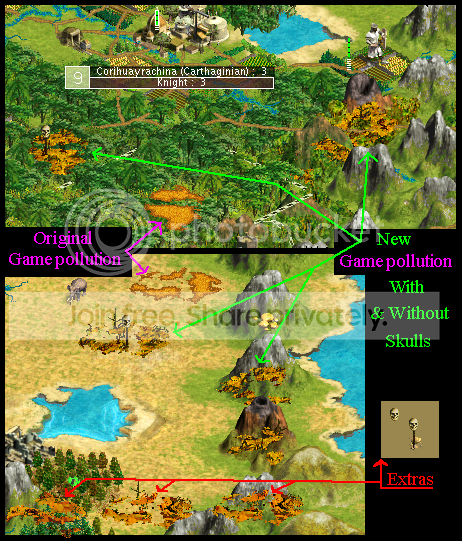
I remember in the first Civ that there was a notion of pollution that started kicking in once you had built factories. The only way to clean it up was to dedicated Settler units to go around and clean it up.
I remember hating the orange patches that came once pollution kicked in while playing Civ3. My younger self would get really, truly pissed at the fact that I, apparently, had failed to have enough foresight as to not damage my precariously acquired land.
Oh, and the orange patches, the god damned orange patches. This thread brought back some really funny memories. It's almost as if I can still feel my frustration at that time.
For those wondering what the orange patches looked like in an older version:
And of course a quick search had me in laughter for a while:
"An option to turn off the %$!&! pollution"
"This has been mentioned before, but I'm bringing it up again anyway. In Civ2 the interface worked much quicker, and the city worker wasn't taken off the tile. Dump some engineers on it and bam! - problem solved. In Civ3 it goes something like this: spend a bunch of time hunting down some free workers on the slower map screen. Figure out how many it takes to clean up the square, move them there, and order them one by one to clean it up. Then, open your city screen. Put the laborer back on the tile (unless another city has taken over the tile at the start of the next turn - then it gets even more complicated). If you're using your workers on automatic (clean up pollution only) you still have to look at every city every turn, and if you have alot of pollution that turn, they may not clean it up in the order you like, causing the loss of shields, perhaps even delaying the production of something important for a turn. This is why I always have some free workers to pile on by hand anyway, even though it takes longer."
And finally, a future techy enters the stage:
"I agree that it becomes tiresome to chase pollution.
Edited my game so that pollution takes less workers to clean up. :mischief:"
There's a game called Banished that has cycles to it unless you are careful. The economic model is complicated enough such that if some event hurts your ore miners, then your ore output drops, when your ore output drops then your blacksmiths farming tool output drops, when the farming tool output drops your food output drops. When your food output drops, your food stores drop your people start starving. It can cause a population of hundreds or thousands to drop to a few dozen. But all the infrastructure you built for your large city becomes a burden at that scale, and it take longer to grow to your old size than it did the first time.
What I found fascinating is after playing for a bit you can start to see these cascades start early and try to stop them and still fail. All you can do is try to efficiently route resources as you watch your entire city fall into decline.
I had completely forgotten about Banished. I started playing it a lot about a week or so before an unexpected life changing event that made me forget about it. I do know I strongly liked it, and its mechanics.
You're not fighting other intelligent agents; you fight yourself and your environment. It's a very intriguing concept.
Collapse of civilization is always pictured as something dreadful, that might not always be universally true, for it also brings change: the slaves of Rome were finally free, the collapse of the Soviet Union also brought freedom (that was really good for those who could take advantage of it), the non German subjects of the third Reich were very happy when that one came down! Somehow the big narrative that is embedded in the civ games is missing these details completely.
Also collapse of a state does not mean that civilization is gone completely. Maybe exploring collapse may be fun too. (At least it would teach an agility that could come quite handy for an individual). However building such a game would be really hard, as it would go against the patterns of historical discourse, there is probably less data to build on.
On the other hand we had a lot of instances during the past century when the established order of things did come to a crashing halt...
I am reminded of the issue of the local maximum. Pretty much sounds like the "collapse", which as you say is never complete, is the action required to get out of a convergent state of society/being
The survivors of the plague had it good though, salaries were up and the institution of serfdom was finished in western Europe, the stage was set for rapid modernization.
Also westerners got some level of immunity to these germs so that people in far off places would just die off when they came around.
The Plague was never really a problem outside of Europe because it required particular conditions. Other diseases did spread, but those didn't have the same apocalyptic effect on society.
When smallpox and other diseases rampaged across the New World the rest of the world didn't notice. It was geographically and demographically contained.
That's not the case now where things like SARS can go world-wide in a matter of weeks.
A failing society could cause considerably more damage today than at any other time in history.
No problem outside Europe? Asia is outside of Europe. Now the plague caused the decline of the Mongol empire - the first trans continental, almost global trading network, see https://en.wikipedia.org/wiki/Pax_Mongolica
In these types of games, when an empire becomes large, all the minutiae decisions very relevant in the early game become tedious exercises. It seems then that in 4X games, the game could evolve in response to the change your empire's complexity, including new UI, new strategic considerations, and even removal of features from the earlier stages of the 4X game. Individual units might be glommed together into a larger superunits. The map might change to a larger field of view..move from warfare to economic rivalries. The point I am making is that the tedium of late levels versus the intense fun of the beginning, is partly because the game stays the same. Change the game, and that expansionist fun can be highlighted again.
It is a game FFS. It is designed to maximize enjoyment, realism is way down the list, and it is obvious to any reasonable player. It would be a "dangerous myth" if state leaders started using Civilization as a model, but thankfully, it is not the case.
And the way the rise and fall mechanism is implemented in practice is simply by ending the game. Once you've won (or lost) you are back to the stone age on a different map.
> It is a game FFS. It is designed to maximize enjoyment, realism is way down the list...
I see this argument often, but it always fails to consider that some players, including me, get enjoyment from realism, simulation and faithful representation of a matter/topic/process.
There is a niche for players who want realism above all.
Sometimes there is a studio that fills the niche, sometimes not. And while the team is usually very passionate, they simply don't have the resources to match to polish of AAA titles. I don't know what the state of the art is for 4X games. You can probably find realistic wargames though.
People already complain the games are too complex. If you add a bunch of knobs for various forms of pollution and exploration, you'd just get thousands of requests to turn it all off.
Cities:Skylines does a relevant thing with traffic. Because the granularity of all activity plays out as individual vehicles and pedestrians going from place to place, as you scale up you run into bottlenecks and traffic issues that affect lots of things in the game.
Some of it's simply dumb AI bugs, but some is a legitimate requirement for designing road flow (which you can do around the bugs as well if you know they're there). A comparable thing could be done with Civilization-type games if you had something that worked at a low enough level of granularity. Rather than 'because you did this, enjoy 20% more productivity', implement it as something where it depends on underlying factors following a good design.
To me C:S is another example of how every town you make has to be an american town: its all about how you place the roads.
The original game doesn't have any way to build something away from a road, even if its something like a park or a statue, and certainly you can't make an area with just pedestrian access. Good luck making a medieval city centre, or collage town.
"Rise and Fall, the first major expansion for Civ VI, makes bold moves to enliven the endgame, like introducing Dark Ages and “city loyalty” , which makes your cities more liable to defect but also gives you a chance of phoenix-like rebirth into a Heroic Age. The intent is to inject that early game dynamism into established empires, encouraging them to, well, rise and fall."
It's all biology. Empires grow and decline and die like animals. The leave offpsring.
There is perpetual growth but it happens in a cycle. No empire "wins", it breaks down and the pieces then grow and compete.
Civ II solved the 4x end game grind in an odd way, contrary to this quote from the article:
"That means that sooner or later, in every Civ game, you’ll reach a point where the challenge is gone but there’s still a long grind before you reach the point at which you have enough capital cities, culture points, rocket launches or religious conversions to win the game."
It solved it with tubeworlds. You were allowed, in Civ II to build, say, 24 x 160 worlds, and that made all the difference. Games were exciting all the way through as you raced to deal with the Civilizations next to you and fight toward the ends. No matter what, when you came up against your last one or two computer opponents, they were advanced civilizations that weren't boring to fight even though you were already close to a win. Very sadly, this was dropped from subsequent games, in which you could only generate rather square maps. I have absolutely no idea why. A great loss. I don't play Civ now.
One game not mentioned in the article and that managed to keep the late game pretty damn exciting was Medieval: Total War II [1].
There's many ways in which the game shakes things up in the late game. One aspect of it is squalor, a metric that rises as your cities grow and advance in technology. High squalor increases unrest. There is very little you can do to reduce it- it will just keep rising over time, as your population grows. And even with careful management the cities at the edges of your empire (where the population tends to have cultural differences to the center) are always at high risk of a revolt, that kicks your army out of the city and replaces it with a rebel force. A hack around that is to artificially cause the city to revolt in an opportune time (when you have a good army to take on the rebels), take it back and slaughter the population, bringing it back down to a manageable size. Still, large cities will always eventually get to a point where they just suck for everyone involved.
The other thing that shakes the late game up is the Mongol invasion. Actually- two of them. First you get the regular Mongols that are the hardest thing that's hit you until then, by a wide margin. Don't worry- they don't want your cities; they just want to pillage them, raze them and move on to the next. Once you 've dealt with them and a few decades have passed, the Temurids come on, who are like your worst nightmare married to its own worst nightmare, but trailing elephants with cannons strapped on their backs. You know you're in trouble because their banner is black and red. That spells "evil" even in a real history-based gaming world.
Then of course there's more stuff that happens in the late game- somebody discovers a New World and a whole new map is added to the game. Things like that. It's very hard with the game to end with total domination. If nothing else, I've abandoned most games because I got bored of the constant strife, that got a little too repetitive after a long enough time, to be honest.
The point is- there was no constant march of progress in this game. You really got the feeling that the world hated your guts, as things went on and the more you played, the more it hated you. Such fun :)
_________________
[1] I played this game primarily as a 4x game, for the city management and the map expansion - I know that's not how it's meant to be played and that the focus was on the realistic battles, but MTWII had probably the best balanced campaign map than any Total War game and playing it this way was way more satisfying than many 4x games I've tried, including various Civs that didn't even come close, to be honest.
I also liked Shogun 2's realm divide mechanic. Right around when you take over ~1/4 to 1/3 of the map, the Shogun declares your clan an enemy of the state and the rest of Japan declares war on you after a few turns. It forces the player to bide their time, build up their forces, and think carefully how they'll plan their late game.
"Computer games are unrealistic". Sure they are, thanks about informing us about it. That's the whole point. In real life, you are not Emperor Of Earth, you do not control economies or vast armies, and if you try to pull any of video-game shenanigans, you'd die a horrible death. The whole point of playing is to escape - in your imagination - into a world where it's not true. I can't believe people can be dense enough to not realize it. So what's the point in such articles?
Civilization was created as a fun computer mediated version of tabletop strategy games where commerce and technological innovation was so hard to simulate it was even more superficial. Decrying them for not being didactic about unsustainable development, poisoning the environment, or techno-dystopia seems rather petty.
That said, it would be pretty neat if it were possible to make a fun game that did all that. The hazard is that didactic games often aren't fun. Don't make games that aren't fun.
Do I understand correctly that they don't have mechanics for overfishing/overfarming/etc either? That seems strange.
However absurd the reasons are, I can at least understand the assertion that climate change is a "controversial" topic, so if your goal is to even cater to the lunatics, fine.
But that overfishing can damage the environment shouldn't be controversial - or is it?
> In Civilization VI, climate change has been written out entirely, even as we live through planet-wide ecological collapse in the real world. The novel inclusion of natural beauty (as ‘Appeal’) only gives modifiers to growth. Famine is a minor inconvenience in your grand plan, as it was to empire-builders in Ireland or India. While older Civilization games included climate change mechanics (Alpha Centauri even set psychic death worms on polluters) Civilization VI is reluctant to take a side on ‘controversial issues’.
Culture victory for United States of America!
To be somewhat less facetious, does the game have any mechanisms for environmental issues? Do you have to handle pollution, loss of species, depletion of stocks through overfishing or overhunting, etc?
I really hate zero-sum thinking. It's true, if we were stuck on this ball of dirt forever, and technology is stagnant, then yes we should conserve a lot. But we're not stuck here (help Musk!), and technology will keep progressing. So I gotta say I completely disagree with this article.
> What evidence do you have for such an optimistic assertion?
Wouldn't the burden of evidence here be on someone saying the opposite (that technological progress will stop)? Technology has continually progressed across human history, exponentially so in the very recent past. Do you think it will stop?
> Technology has continually progressed across human history
This is the so-called "Whig view of history", and while it looks superficially true it ignores those cases where technologies have been lost, abandoned, become uneconomic to maintain, or given up for political reasons (e.g. China abandoning its exploration fleets).
How do you account for the European "dark ages", for example?
Collapse is possible: supply chains may be extremely vulnerable to certain risks, such as a war in Korea or an earthquake in Silicon valley. Decline is also possible: life expectancy is starting to fall in the US, as it did in Russia in the post-Communist period.
People need to stop comparing the fall of pre aircraft civilizations to the fall of a post Internet civilization. You wouldnt compare the fall of the roman empire to the extinction of the dodos. We've made enough strives in technology to where it may be fun to say oh history repeats itself, but at this level of unexplored territory you're going to need facts to prove your point.
Why? The technology being better does nothing for human nature. The very things that give us so much for so little also make us vulnerable to very small attacks. We have a police force that’s defeating out opponents for the time being, but as the IRA told Thatcher, the defenders need to be lucky every time, the attackers only need to be lucky once.
>How do you account for the European "dark ages", for example?
The lack of a printing press? From what I have read, the creation of the printing press is what helped lift Europe out of the dark ages and presumably prevented it from ever returning to another one.
The latest thinking on the European dark ages is that they occurred because of the Huns-- they pushed hordes of other barbarian tribes into and overwhelming Rome, and brought Black Plague which killed half of Europe.
And we all know that mass migrations and plagues can’t happen today! No really, if anything the technology we have makes both of those things much harder to control. Climate change leads to drought and famine, which leads to political and social instability, war, and mass migration (as we’ve already seen recently). Those same forces, along with people loving cheek to jowel, with access to rapid mass transit, is a risk for plagues. The current “solution” is runaway spending on the military, and wars that seem to never end.
Also, resource collapse. Yemen is in the process of running out of water; either some large expensive solution needs to be deployed in a very poor country, or a million or more people need to move or die.
I don't see anything in these articles that proves that climate change is either the primary proximate cause or a necessary cause for the migration from the Middle East to Europe. It is still more simply explained by political expediency than it is by climate change.
Technology has regressed seriously at least two times that I can think of. After the Sea People invaded Mesopotamia, and after the fall of the Roman Empire. Arguably in some ways after the colonization of America too, a lost of technological knowledge was lost. It took several centuries to recover from each of those, and technology right now depends on resources that are not renewable and that we are making more difficult to get. If we regressed again, it could take a very long time to recover, because of the exponential growth you mention.
The eastern mediterranean basin. AFAIK Assyria wasn't directly affected, the polities directly affected were Mycenaean Greece (collapsed), the Hittite empire of Anatolia (collapsed) and the Kingdom of Egypt (which repelled the Sea People but likely at high cost).
The Assyrian Empire contracted at a later date, possibly as an indirect consequence of the collapse.
> If we regressed again, it could take a very long time to recover, because of the exponential growth you mention.
An other issue is the ability to access resources. As a civilisation progresses it consumes easily accessible non-renewable resources, the more it progresses the more difficult to access the resources it consumes entirely.
A civilisation following the collapse of the current globalist one would have a very, very hard time accessing non-renewable resources to fuel its growth.
North American pre-Columbian societies were all Stone Age and most were pre-literate. One of the most advanced, the Mayans, collapsed hundreds of years before Columbus. The most advanced Aztecs worked with metals but hadn't discovered the wheel (beyond toys) or bronze. No doubt the collapse from European contact resulted in tragic loss of life, loss of culture and loss of local knowledge of medicine and agriculture, but on net it actually ushered a wave of dramatic technological advancement among indigenous tribes-- particularly adoption of the horse and horse-riding, which the Spanish tried to make illegal. The tribes in North America that adopted the horse (and later, firearms) rapidly conquered the tribes that did not, until they were ultimately displaced in turn by European settlers.
During the 200 thousand years of human history, technological progress was pretty flat. Low hanging fruit like electricity and nuclear power took a long time to develop. Most of our dreams remain just that.
Recently, apart from CS and genetics, we are stagnant.
On top, progress is trickling down pretty badly. We are wasting lots of resources on conflicts, essentially to ensure that the one percenters keep their possessions, including means of production (so that capital can further concentrate).
We will probably lay the planet to waste, by wars and resource exploitation, much sooner than technology will advance enough to save us.
The ingeniuty of the human race is not its predominant feature.
> Recently, apart from CS and genetics, we are stagnant.
That seems a pretty weird argument to make. "Apart from all the people with black hair, nobody has black hair" These two fields alone are wide ranging enough that they can touch almost everything on earth. Furthermore, fields like material science have progressed an incredible amount due to widespread availability of computing power. So have agriculture, logistics, manufacturing, mining, medicine and education. We may yet destroy ourselves before we attain utopia, but it won't be because our technology is too stagnant.
There's no evidence that tech is stagnating but quite a lot that the pace is accelerating, perhaps geometrically. There are two reasons-- one is the integration of many more people into the western/global structure of scientific and material progress (particularly in Asia and South Asia) and the second is the complementary impact of advances across multiple fields. Consider for example, the enormous impact of internet communications tech on medical research.
The Wright brothers, working in a bicycle shop, invented fixed wing flight in 1903 and it took less than 100 years for western civilization to develop jumbo jets and space planes.
It is generally considered impossible to prove a negative. Even if you can prove that something is not now the case, it is usually not possible to prove that it will never happen.
Therefore, the burden of proof is usually assigned, fairly objectively, to the argument that makes a positive claim, e.g., that something will happen or something is true, etc.
In this case, the claims are: 1) I believe space faring technology will advance enough to the point that humans will be able to leave our planet permanently, and 2) I am skeptical of 1.
Two is like the null hypothesis. This cannot be proven; it is the default until #1 is proven. Therefore, #1 should objectively have the burden of proof.
Kind of like how financial disclaimers will include something like "past performance is not proof of future results".
It's not that the claim that "technology will continue to progress forward" is wrong. I think it's a reasonable belief. But that is not itself proof that it will continue on. Reasonableness of a claim is not proof of its truth. Intuition is not very good evidence.
Even if we assume that technological progress will be effectively infinite, that doesn't mean that any specific technology will come to exist.
Don't think it can be decided "objectively", but we usually assume the ordinary scenario is correct and require more evidence the more extraordinary the deviation from the norm (AKA Occam's razor).
Sometimes we explicitly agree on a position, as with the US's "innocent until proven guilty."
FWIW I share your point of view. The article is as political as the game itself, they just take opposite stances.
That said, there is a kernel of a judicious argument about Progress in Real Life (PRL) and 4X games, and that's that real-life progress is deliciously complex, full of accidents and unpredictable. Real life progress is a roller coaster that for the most part goes up (don't take my word, just lookup the data), but people step on it coked to the bone on that opiate called "the news", and boy they are going to throw up to the smallest lurch ... but I digress...
4X games on the other hand lack all the complex system amplifiers, which is to expect because well they need to run in far more modest hardware than PRL, and for most people the 4X game itself is a relatively mild psychotropic that they use to counteract the effects of daily boredom and of the nick drugs : the apocalyptic phantasmagoria of click-bait media.
If humanity “retires” we’re guaranteed to go extinct anyway. At the very least there are periodic extinction-level asteroid impacts that will wipe us out if we stay earthbound.
Yeah this guy mentions stellaris then dismisses it when actually it solves most of these problems. More than what he mentioned can happen to your society to set it back.


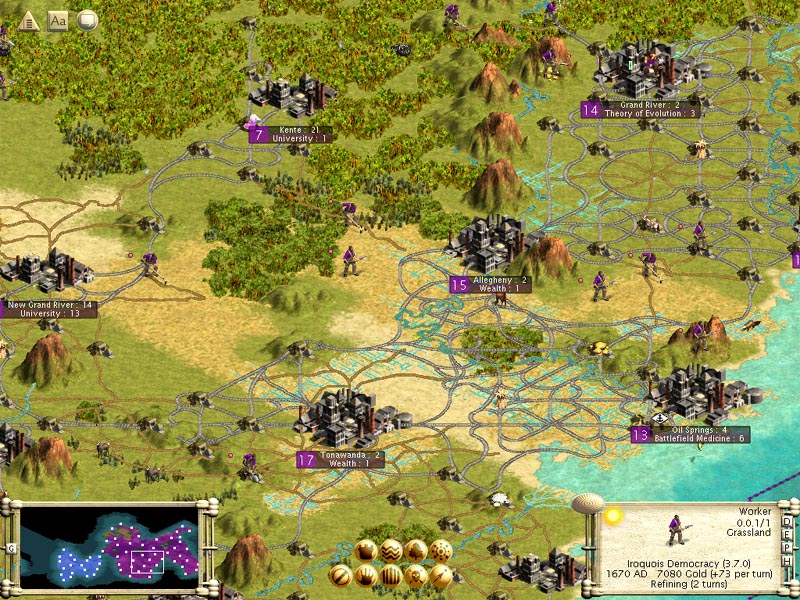
And I don't think the thesis put forward by the Civilization franchise is necessarily wrong, however dreary. As with anything, it depends on the level at which you engage with it, and how much good faith you apply and which things you choose to emphasize or not emphasize. Economic strength and accumulation of resources and sheer population do have a lot to do with who dominates. But maybe it takes other stuff, too. Maybe playing a game doesn't mean you're ignoring it, and "correcting" the thesis of the game doesn't mean we're due for an overthrow of a grand cultural dogma.