They're just USB-C dongles that snap into the chassis.. You can see better shots here: https://frame.work
This is an unpopular opinion, but I think this proves that Apple was right to dump legacy ports. This solution is sort of clever but it sacrifices a ton of internal space that could have been spent on a bigger battery. USB-C, and the correct cables, are all anyone needs.
(the Nespresso analogy is ridiculous, a laptop doesn't exist to consume adapters. But I presume you were enjoying a little tongue-in-cheek with your coffee)
>I think this proves that Apple was right to dump legacy ports.
How it proves it? Those guys do not drop ports, they just make them modular.
All the "saved space" in Apple laptops become amazingly wasted space in your bag with tons of adapters and wires.
I still dream to meet the one who made such 'wise' decision to tell him what I think about it personally!
>USB-C, and the correct cables, are all anyone needs.
I am not sure you can know what anyone needs. For instance you do not know what I need.
I wish you'll be around when I need to copy my files from the camera with idiotic dongle in the field when time is precious.
I would love then to hear how sticking card directly into the slot without any headache is less comfortable than looking for some dongle in the bag while holding your camera equipment and then hanging dongle on it's wire because there is no table around to put your laptop on or put it somehow on your lap and try not to move to avoid it breaking during the transfer because then you'll have to start again transferring your important pictures. Then pray it will work
because some times it will not when you need it most.
Removing sd-card reader slot is example of the most idiotic design decision I can imagine. It is taking what works perfectly and destroying it for no reason at all. It is pure damage without any benefits taking size of it into account.
It was done by people who never used laptop for transferring photos from the camera using sd-card.
They never thought that while you transfer with the sd-card your other card is available to continue shooting in critical or unexpected situations. This is what makes the difference between making some shots and not! I would never understand this idiocy of removing sd-card slot to "save space".
The whole point of laptop is to save YOU space and headache or space in your BAG! Not in the laptop itself by making it useless. Such a dumb decision to remove useful ports. Goodness.
I think the SD card example encapsulates the issue perfectly. I'm pretty sure that in 2021 that is an _extreme_ niche use case. I feel like only extremely serious photographers and perhaps a particular slice of musicians use them. It makes absolutely no sense for them to have that built into the laptop. 99% of people who own Macbooks or whatever don't own an SD card dongle because they don't need it. However, and extra USB-C port can be used for a multitude of things, including being an SD card reader if you have the dongle.
It's completely logical.
> The whole point of laptop is to save YOU space and headache or space in your BAG!
It most certainly is not. The point of a laptop is to strike a balance between portability and usability. Requiring the extra like two cubic inches of space in your bag for a dongle is assuredly not a design concern.
And most "extremely serious photographers" today are probably using cameras for which SD cards are not the storage format (or at least the preferred format.)
It Depends how you measure "extremely serious photographers".
Starting from Nikon d610 you have descent quality on sd-card plus portability in the same time. I understand that you can't put all the ports in the world in the laptop and while CF Cards reader would also be useful for photography I think sd-card reader or even micro-sd-card reader gives a compromise for mobile solution that covers many needs. Lack of this sd-card reader gives additional headache and nothing more useful as I see it.
Exactly. And since we might carry more than one model of camera with dissimilar memory cards, the Mac could need 3 or 4 slots. That’s why the good pro photo USB-C adapters have 3 or 4 slots.
Further, those readers seem to be made /just/ fast enough to read ahead of the current speeds, so when new speeds come out, you need a faster reader. That works fine if you have a USB 3.1 or USB 3.2 adapter, but not so great if the reader is built into a laptop with an otherwise much longer life.
> It makes absolutely no sense for them to have that built into the laptop. 99% of people who own Macbooks or whatever don't own an SD card dongle because they don't need it.
That's the issue - you are speaking only from an Apple user perspective. Android (and other non-apple) phones allow us to extend our storage with sd cards, and they are mostly used to store and transfer photos and videos.
Is that an Apple user perspective or just reality for the average user? I recently had an Android phone for a while and never thought to use an SD card because it had plenty of internal storage. I can say the same about my family and friends who use Android devices, I can't think of any who use SD cards at this point. Even in the past when I did use an SD card in my phone, I simply plugged my phone into the computer and wrote to the SD card that way, I don't recall ever removing the card.
> Android (and other non-apple) phones allow us to extend our storage with sd cards
/me looks glumly at my Apple-ized Samsung Galaxy S6Edge, with no SD card or removable battery. (Both of which would make the S6/GearVR combo significantly more useful...)
I'm an Android user whose phone supports microSD. I never take the card out of my phone -- it's a PITA, requires an ejector tool I always manage to misplace, and I think I'm only supposed to do it with the phone powered off -- but I do plug my phone into a computer to move files on and off of it. I do this with a USB-C cable.
If we actually got enough USB-C ports to make up for all the removed ports (like, 8 or so?) then I'd agree with you, and be willing to put up with the temporary pain of dongles for the sake of a glorious future where everything's USB-C. But we've ended up with the worst of both worlds: say I bring out my laptop for movie night and I want to plug in power, projector, surround sound, a DVD drive, and a mouse, that was easy 5-10 years ago and it's impossible now.
They make hubs/docks with many ports that only need one of your USB-C ports. There's also daisy-chaining to consider. I think you most likely could connect all those things.
I ended up having to daisy chain a dock to a USB hub, and then I would get errors if I connected the wrong things to the hub because I was breaking the 7 hub limit (turns out a lot of things have extra internal hubs). Obviously I did get it to work eventually, but it felt a lot more complicated and fragile than in the old days.
>I think the SD card example encapsulates the issue perfectly
It does. Micro-sd-card reader fits even in raspberryPi Zero ... Neglectable "space saving" advantage vs huge usability disadvantage.
> The point of a laptop is to strike a balance between portability and usability.
I think MacbookPro should be about philosophy of amplifying creative person with power tools for creativity in a portable way. Not a dumb machine mimicking more and more some TV . While this it should also do easily it shouldn't do just this, I think.
From my perspective of extensive use of a laptop some people barely use laptops at all and thus perhaps they better be designing something else because for me it appears they have no idea what 'Pro' usage is. When you travel you never know what environment you'll have and therefor ports and connectivity make a difference between: Creative idea done/ not done.
>Requiring the extra like two cubic inches of space in your bag for a dongle is assuredly not a design concern.
It's not 2 cubic inches. It's huge adapter with all missing ports. Why Pro Laptop should consist of two parts is beyond me.
Again look at my use-case. I have no place for dongles nor time for dealing with them.
If those real 'Pro' requirements are not a design concerns then perhaps MacbookPro should not have 'Pro' in the title in my opinion.
Its ~2 cubic inches and doesn't dangle on a cable so you don't need a table/lap.
As for your more detailed post you just linked to:
> Only for that purpose more ports are justified because I would prefer to have 4 at least to connect all 3 iOS devices plus hard_drive for backup etc. If there is additional monitor around that I could use I would love to use it which means I need HDMI/display port.
USB4/thunderbolt 4 allows for type c hubs that also support alt-modes like displayport alt-mode so you can have a small cellphone-sized hub to significantly increase your ports: https://www.amazon.com/dp/B08RYZJY8M
> I would also need HDMI/DP/DVI or even VGA port to have external screen connected.
Surely you're not suggesting that laptops built in 2021 should have a VGA port? This is exactly what tomtheelder was referring to when he said:
> I'm pretty sure that in 2021 that is an _extreme_ niche use case [...] 99% of people who own Macbooks or whatever don't own an SD card dongle because they don't need it. However, and extra USB-C port can be used for a multitude of things
Just think of all the extra thickness Apple would be adding to their laptops just to fit a VGA port 99.9% of people would never use.
>This looks to satisfy all your requirements from your original post:
Thank you for the link. Unfortunately it only looks so.
It satisfies only partly because it's still headache to remember where it is, remember to take it and when something like that sticks out of your machine probability to break it when there are people around is very high and not unusual. Also you can tilt accidentally your laptop and it cat potentially break the port completely.
With all that said the reality now for instance that it is simply not available in the country I am right now unfortunately. I cannot move because of the covid situation and I am limited with what I can order. My MacbookPro has died gracefully (you can read how if you wish: https://news.ycombinator.com/item?id=25809097) I have managed to get M1 machine but now I'll have to deal with adapters that are available around.
Because I do not have sd-card-slot my photography is limited to zero currently until I find adapter that would work. I have additional headache to choose one that works, and they lie about the specs and you never know what you get so this is the reality of all those theories about 'oh you can get a dongle'.
I just wish to add that when you are really mobile and travel in different countries it is Not unusual situation. Even if it's developed country it's not easy to order something in a small town or even in a big town. Usually small towns do not have something you need, you can count on that. Probably you can buy a new Mac probably like I did but it's M1 with 2 ports and some nice adapters will be not available there. Again this is the reality , not the theory where you can access everything you need whenever you need it.
The second item you've mentioned is nice. Thank you again. It can be useful when I'll be able to reach it. Right now all my drives are usb3 to fit MacbookPro I had. This hub is also requires power supply brick as I understand and again it would be simply impossible to get the hub you've mentioned where I am at the moment.
So in my case it will be huge adapter hanging on wire and let us pray it will work as expected.
>Surely you're not suggesting that laptops built in 2021 should have a VGA port?
No, I am not suggesting that. HDMI an micro-sd-card reader do not add any thickness though and are still very useful for flexibility in real world. When I took my previous Mac I thought I will not use HDMI but mobile reality made it so that at some point it was the only way I can use it and extract data from it and the external port allowed me to boot gnu/linux. The M1 Mac on the other hand become not bootable in the first day because of the bug in DiskUtility and I needed 'another Mac' to make it even bootable again so from my perspective I did not upgrade I have downgraded.
>_extreme_ niche use case [...] 99% of people
For me it's not about how many people use something it's about what a portable computer allows you to do and how flexible , productive and creative you can be with that tool. I do not want to go further about what else 99% do not do ... following majority was never too exciting for me.
I use my notebook's SD card reader all the time. Cameras, ARM SBCs, 3D printers, random SD cards I find laying around... There's plenty of use cases for an SD card reader, I certainly use video out on my notebook much less.
It's also the main storage on the Wii, DSi, 3DS, (maybe Wii U, but it also had USB storage. I guess the Wii did too.) and Switch. An SD card reader lets you back up your game saves or install homebrew.
More recently there's the PinePhone as well. It's not just expandable storage, you can boot off the SD and have all your OS and files there.
I would say I definitely use SD cards more than flash drives now.
Mostly my and my friends' homes, but I do remember finding an SD card on the ground once... Do you think I'm being targeted by spies? :) It had someone's pictures on it, but no identifying information, so I had no way of returning it.
Thankfully random SD cards should be much safer than random USB devices, but it's probably better to be careful.
> It had someone's pictures on it, but no identifying information, so I had no way of returning it.
You could hav put your laptop on a network with heaps of monitoring going on, and then mailed it back to NSA/GRU/MSS/Mossad as required based on the ip addresses your machine started connecting to...
I generally think the whole dongle issue is over exaggerated, you can mostly just buy new cables (once) and be done with it. The SD reader is one of the big exceptions I think. If you always need a cable to do something, you can just replace the cable with a USB-C one and be done with it. Having an integrated reader is handy for a fair number of people and it’s something where you don’t otherwise need an adaptor.
The new cables means your cables aren't backwards compatible though - one day you need to plug in a display port cable to someone's desktop/old laptop and you don't have the cable on you, because you replaced it to avoid dongles.
Dongles are both cheaper and more flexible than replacing the cable, at the cost of having a slightly shittier experience.
I'm not sure what you need "tons of adaptors and wires" for since you're only talking about SD cards, but to address that one example: what percentage of laptop users are professional photographers? One percent? A quarter? There are at least six fashion photographers in my apartment building and even I know they're a negligible slice of the population.
Apple should not be designing their laptops around the needs of 1% of users. That's just dumb. They should be designing for most users, and they are.
Which strategy makes more sense…
1. users who need SD card readers should carry around SD card readers
2. users who don't need SD card readers should carry around SD card readers
I don't need an SD card reader! I'm glad Apple is using that space to make the laptop more portable with the most battery possible.
The whole point of laptop is put as much power as possible into a device that is as portable as possible. The point of a bag is to carry around shit that YOU might need and the rest of us don't. Goodness.
How far do we take this? What percentage of Macbook users use the tilde key? How many users open the terminal? What percentage of users use multiple desktops?
The reason Excel remains the dominant spreadsheet software is because it has dozens of features that other spreadsheet applications don't have. Each one of those features is only used by a small portion of the user base but if you add up the users which use at least one of these features it starts representing a significant chunk of users. Each of those feature independently isn't worth implementing in competing platforms because "Google sheets should not be designing their app around the needs of 1% of users", but the culmination of all of those features add up to a platform Google Sheets just cannot compete with.
Is the space actually being used more effectively? What can fit in the laptop without a SD card slot that couldn't fit with one present? Why is a smooth side with no ports somehow more valuable than a side with usable ports? You can't think you'll see any savings passed along to use for Apple taking out a part that costs them a few dollars at most. Removing the feature won't save any consumers any money, only reduce usability overall.
The reason that Excel remains the dominant spreadsheet software is that it's the best spreadsheet out there, and it's almost universally installed on all school and business computers.
That’s my point exactly, I don’t want to buy the laptop you need either. Since Apple can’t make models for all users, they design around the needs of most users. And practically nobody needs SD card readers.
Before going any further you do realise that there is enough space for micro-sd-card reader even on raspberryPi Zero?
And I hope you do realise that I am talking about sd-card reader just for the most obvious example, it doesn't mean I have nothing more to say or wish from laptop.
I think this is not about what majority wishes when you develop a tool that you label as 'Pro', it's about what device can and cannot do and as such what Man can and can't do using it!
>I'm not sure what you need "tons of adaptors and wires" for since you're only talking about SD cards...
First of all it is a real mobile usage. And I mean serious usage 'on the go' (and it could be 3 month + of 'the go')
My laptop is the only machine I have and could have in such scenario. And as far as I know this is exactly what laptop was meant to be - device for mobile work.
My use-cases are:
I do Software Development:
- Developing software for iOS: Which means I need to have one of each kind for testing iPhone/iPad/iPadPro and connect each of them periodically. Only for that purpose more ports are justified because I would prefer to have 4 at least to connect all 3 iOS devices plus hard_drive for backup etc. If there is additional monitor around that I could use I would love to use it which means I need HDMI/display port.
- Developing software for MacOS. I am developing FileManager for Mac and few other projects on the go. Which means Xcode and resources it requires. Also external monitor port hdmi/dp - any I can find around depending where I am.
- Developing software for GNU/Linux. which means sometimes a need for Ethernet port to track down issues.
- Using Terminal for remote connections to raspberryPi/s which means wired connections when there is a need of speed or some problem. It also means I use sd-card-reader for this too.
- Developing software for reMarkable tablet. which means VM GNU/Linux machine on Mac which requires more_storage/more_memory/more_processing_power and again free USB-A port to connect rM for speedy connection/charging.
- Making some hardware projects on the go: Arduino/ESP32/8266/raspberyyPi etc. which means periodically connecting those and I must have cable connections when something breaks and wifi would not help. I also do not need additional dongle in the chain when tracking down some problems. It saves a lot of time to have less items to check as the check itself takes time * number of times you do it. Needless to say that those devices barely work with simplest USB 2.0
I do Music:
- I play Guitar. So I need to connect a Guitar for recording/performing, which means I need line-in .
- I sing and if I wish to record it I also need external mic which means one more usb/line-in.
- I play Piano: If it's real piano the same needs for mic if it's electronic piano - perhaps line-in, if it's midi - usb.
You know at least one line-in would be great just in case I wish to connect something in creative situation for creative purposes.
I do massive Photography/Videography:
- Some times work as photographer/videographer. I have Nikon Camera with sd-cards and need periodically but intensively transfer of huge Video Footages.
Wifi for such sizes is simply not an option. I also need ports to connect few drives at the same time.
I need diff types of ports if I work with other people and usually they are not equipped. Again the difference sometimes: it's done or not due to some dumb limitations.
- I do Argentinian Tango Teaching/Dancing/Performing.
Which means I need remote control to stop/play music during the class. Where the IR port that worked fine?
I need wired audio connection to whatever-audio-system-i-can-find and if my bluetooth speaker doesn't_work/not_enough for certain halls . I would also need HDMI/DP/DVI or even VGA port to have external screen connected.
I never know what screen will be available at some place. Again the difference would be: It's doable/Its' not doable.
- I also need to relax and watch movies some times and I also wish to do it with friends sometimes which means HTMI/DP/DVI/VGA whatever we can find.
I do not know your use case but as you can imagine with all that activity the last thing I need is another dumb dongle to deal with.
Since I travel with my guitar I have 'literally' no space in the bag for adapter and wires because most precious things I have to take with me on the plane and I have to pack them really tight if I wish to avoid boarding complications.
I simply have no space in the bag nor space in my mind to deal with another stupid problem like dongle/adapter.
There are projects that require all of theses use-cases simultaneously. And since I wish to do things with top quality possible I need all the equipment to work perfectly too because I relay on it and if it doesn't work it usually means something will not be done. I am sure any pro would confirm that. I simply cannot afford having some stupid dongle. Believe me. I need MacBookPro and it should be really 'Pro'!
Again, I do not know your use-case but for me some people are just barely using laptop as laptop at all for goodness sake.
And if we are talking about 'Pro' shouldn't we listen to people like me who is literally using all the features to the full extent.
> All the "saved space" in Apple laptops become amazingly wasted space in your bag with tons of adapters and wires.
Maybe that's the case for you, but that's far from universal. I have zero need for any adapters. At work, I can use usb-c to connect to my monitor, and if I need to present in a meeting room, I do it wirelessly.
At home, I can use airplay to share my screen to my TV.
I'm down to exactly one adapter in my bag. One usb-c male to usb-a female stubby little guy.
If I'm heading to someplace where I think I might need more than 1 usb-a port or a situation where I might need a bit of a usb hub I just pack this little 'dock dongle' that's about three inches long and an inch wide that has three usb-a ports (2x3.0 1x2.0), an hdmi port, a sd and tf card slot, an ethernet port, an audio jack, and a usb-c power input port... cost me all of 60$.
What you describe is exactly the headache I was mentioning and dreaming to avoid. I do not need part of the laptop separated from the laptop to have additional task to think when to take them together and when not to take them together.
I do not want to search for this 'little guy' in the dark and be stuck without it when I forgot to take it because a lot of other things happening in the same time around or I lost it or somebody took it because he thought it belongs to him by mistake.
Having the dongle headache or not in certain situations means missing shots or not. And I speak from experience of shooting intensively in addition to doing other things during 5-7 days in a arrow where you do not always have time to eat/sleep and surely no time to waste for this dongle BS.
> Get the machine that suits _you_. Unless you want to run Apple OS because then you're not given choice.
And that is exactly the point. I used to be a very happy customer of multiple Macbook Pros over almost a decade. Currently, I am still using my 2015 Macbook Pro 15" with maxed out specs when not in my home office. But all the later models went downhill for my needs. The new Macbook Air M1 is the first model that I am thinking about buying. It is probably powerful enough to work on it, and I think I actually get some value back from the saved spaced due to dropped ports. Even the 2015" Macbook Pros with 15" are at a thickness were I simply see no point to remove even half a milli-meter of thickness. I would gladly use a thicker, heavier variant if it had multiple different ports including Ethernet. One problem that I had over the time with all Thunderbolt dongles was that the physical connection became unreliable over time. That is hassle I don't want to deal with.
For me it's not about what suits who. For me it's about what philosophy you put into design of a portable computer as a tool and what it can allow/encourage you to achieve/create.
If "using it on your lap, without something hanging" matters to you (like the parent) and you wanted something more 'rigid', things like this exist: https://smile.amazon.com/dp/product/B07PCP5J4Z
Yeah I'm in complete agreement. A single "dock" dongle with all the ports you could possibly want are cheap, light, and have smooth designs that won't snag on anything.
I have one buried in my bag that I almost never use. It's surprisingly rare that I need an Ethernet or HDMI port but they're there if I need them. In the meantime, there's more room inside my laptop for battery.
Even an extra 5Wh of capacity is about an extra hour of use.
For those who use a laptop outside office desks, there is a lot of difference between flimsy setups with dongles hanging on wires, and the mechanically solid laptop case. Much easier to carry it around in one piece.
Saving 0.1% of space for micro-sd-card reader and having headache of dongle for every photo/video transfer? Doesn't appear reasonable at all. They have found space for micro-sd-card reader on raspberryPi Zero ... It's absurd not to have it even on the phone.
> Imagine your laptop with the power supply built in instead of as an external brick.
You know what? Great! One thing less to care separately . It would be bad thermal solution though.
By the way the brick itself was coming with extension cord. Now it comes without it. Imagine during your travel squeezing it in some public place with bad socket to charge it when it doesn't fit well enough and could even fall and break and your life depend on your ability to charge it. Do it few times during few travels, then you will understand how "reasonable" was to even to remove the extended power cord from the brick.
Many things appear 'reasonable' on the paper until you use them in real life.
For my M1, I thought I was in a pinch when I forgot my charger at work. I was fine, though—I just plugged in my 18W USB-C phone charger and used it while WFH.
I must be doing something different from you. I have one adaptor on my desktop which lets me get display/ power/ USB A. It’s nice because it means removing the laptop means unplugging one thing.
I don’t take any dongles with me. Or any adaptors. My laptop case is just a protective sleeve and sometimes I bring the power brick.
It would be nice to have one USB-A port, and HDMI, but it’s not that big of a deal either.
Apple burns almost all of their space savings on making the machine thinner, to the point of absurdity.
Apple is content to push everything into dongles (which you have to carry around anyway) to get it thinner. The point at which I can't have a wired RJ45 ethernet port is already ridiculous - that is not a thick connector. Same with fullsize USB ports.
Battery life there are hard limits as well: nobody is making a laptop with more then 100Wh, because that's the limit that you can carry onto an aircraft.
If you are bringing your laptop to a coffee shop, you probably won't need an ethernet port anyway, so you can leave the dongle at home. Lots of mobile use-cases don't involve plugging in to a ton of things, so why waste space having ports for it?
We're mostly programmers here, with nice keyboards and big screens as a necessity for work. On the other hand, lots of people are completely content with the base laptop. Making things easier for us at their expense is probably not a great business decision.
But lots of other mobile use case do involve plugging in to a ton of things. I would like to have the option to get the ports builtin. I am not arguing they should stop making those crippled variants without ports.
Luckily, macOS is going downhill as well, therefore my pain will end when the next version has not resemblance to a Unix system any more. The day Apple starts migrating its desktop OS to hamburger menus, I'll wipe and sell all my remaining Apple hardware.
They could make different models and operating systems for every niche I guess, but people who need lots of ports and a UNIX-like experience on a laptop are pretty far out in the tail of the distribution I think.
I dunno. I've never owned a macbook because Linux has been good enough for most of the time I've seriously been using computers for work stuff. Even if you aren't a Linux enthusiast, the time to switch for developers was more than a decade ago, IMO.
Agreed, the point when I start to have to choose any two of usb-tethered phone / usb to ethernet / usb to wifi headset / usb to serial really gets infuriating.
There are ultra-slim foldable RJ-45 connectors[1], which manufacturers could use if they could be bothered but they don't, because they would rather save the BOM cost of it and advertise the WiFi capabilities instead.
Because it's meant for ultra-slim devices that will be docked on Thunderbolt 99% of the time and that foldable RJ-45 jack is for the "in case of emergency break glass" scenarios, that 1% of the time when you need to patch into a server physically without wasting time looking for a dongle, not for you to constantly plug/unplug ethernet cables in your laptop.
If your uses case requires you to constantly plug/unplug ethernet cables in your laptop then you need a workstation class laptop with a full sized RJ-45 jack, not a sleek thin and light.
The connector's on the top, the bottom is simply a retention clip. If it breaks, you can replace it with tape, or simply resting the laptop on a surface while the cable is plugged in.
I mean all people. When you work on the laptop you probably connect more things than a network => you have a dock => you don't need the rj45. So there might be negligible amount of corporate workers that need it, and some portion of tech workers, maybe. But overall, out of all customers, it's not enough for the hassle. Especially since it has drawbacks for the rest of the customers.
I mean. Really. That strikes me as willfully ignorant and arrogant. Clearly it's heavily used, especially in professional/corporate environments.
FWIW I use WiFi if I have to on the move.
But at home and office it's hard wire all the way.
In the office it's not even an option, everybody must.
At home, it's a quality of life thing.
The speed drops and disconnections and unpredictability of WiFi are not thing of the past yet. For some there's a security issue as well, real or perceived.
Wire just works.
Edit: other examples - gaming laptops; secure networks; dense environments either urban or corporate; anything that needs predictable connectivity, bandwidth and lag really :-/
Both my own laptop and the laptop from my employer (a large company) are used almost all the time on wired Ethernet, the main exception being during business trips.
"Clearly it's heavily used, especially in professional/corporate environments."
It's so clear that they removed it from their lineup? Clearly you're wrong. I have two Macbooks work/home, and a USB-C dock has been life changing in its awesomeness.
1. Is a particular connector still used/useful on laptops - my statement is that RJ45 is absolutely still used on laptops, and went into some examples / use-cases.
2. Separate discussion, hopefully informed by the first, is how do we do that - built into laptop or via a bunch of dongles.
Apple in particular removing it from their laptops does not speak one way or another to corporate/professional environment requirements. Their approach is "use a dongle/dock" which in their view is compatible with whatever use case is needed (and some people disagree, which is fine - lots of vendors and in particular HP/Dell/Thinkpad all have robust professional/corporate/roadwarrior models with dock, port and even pointing stick capability).
> It's so clear that they removed it from their lineup? Clearly you're wrong.
They also removed scissor switches, sd card readers and hdmi. But they're bringing those back (or have already), so they don't seem like a good authority to appeal to here.
Welcome to dense urban environments, where the list of available wi-fi networks is well above fifty and the throughput well under 100 Mb/s on a good day... When I sit at my desk, I plug the RJ-45 and I get 1 Gb/s - no ifs, no buts !
I use mine nowadays, because my room is just far enough from the access point for occasion zoom drops. The 'better' solution would have probably been to put an access point right in my room, but I already have an RJ45 dongle + ethernet cord and I trust a cable connection to have less drops than wifi.
My laptop is sitting at home 1,5 m away from my Unifi access point and the network cable is still measurably more reliable and performant. Wifi might have won the amateurs.
I would say I run into a situation where I dig my RJ45 dongle out of my bag once per year still. Usually if I'm in a different office or trying to fix Wifi or something.
For me the dongle is annoying but probably sufficient.
I've also worked in offices where the Ethernet was better because it didn't require VPN access and was more reliable, but in those situations I plugged it into my monitor rather than directly into the laptop.
Apart from what everyone else was already saying I have another cool use case: When transferring large files between two devices it's neat to be able to establish a point-to-point Ethernet connection between them, configure static IP addresses and netcat the files over it. It's fast, I don't need to encrypt anything and I'm not hogging anyone's bandwidth.
> By connecting each device directly to a port on the switch, either each port on a switch becomes its own collision domain (in the case of half-duplex links), or the possibility of collisions is eliminated entirely in the case of full-duplex links. For Gigabit Ethernet and faster, no hubs or repeaters exist and all devices require full-duplex links.
> This solution is sort of clever but it sacrifices a ton of internal space that could have been spent on a bigger battery.
I wondered about that as well. Looking at the picture at the top of the main page, I see one small battery, and electronics that take up 2-3x the size of normal laptop electronics. Most current laptops have 60-80% of their chassis space occupied by batteries.
However, the description mentions a 55Wh battery, which is quite reasonable for a thin-and-light laptop. It says 1.3kg, which is a little heavier than desirable for the form factor (1-1.2kg), but not by much. On balance, this looks like a much more reasonable set of tradeoffs than past "repairable laptop" efforts I've seen; Framework is putting serious hardware engineering effort into this.
Looking at the design, I'm not sure that expansion card concept is responsible for the thicker case. The reality is, supporting replaceable memory, mainboard, etc, likely necessitated a somewhat thicker design.
Assuming that's correct, I think it's kinda clever... it's basically a dongle system that allows the modules to sit flush instead of jutting out of the side of the laptop.
> This solution is sort of clever but it sacrifices a ton of internal space
this is true, yet... I'd be okay with that, to be honest.
My current work laptop (a dell latitude 7390) is a jewel also because it's got a lot of ports. I have used them all at least once, but quite frankly, never all at the same time.
So yeah, being able to unplug a port and plug a different one it's almost the perfect middle ground.
we're pretty much all carrying dongles anyway (not me, the dell latitude 7390 has all the ports i might need)
Well, sort of :-) Nespresso is a famous implementation of a "your basic machine stays static, you swap out a different element of the system based on temporary/current needs, but you can only buy those elements from one vendor" pattern. Printer ink cartridges are another.
Yeah, add-on cards to a computer aren't consumables per se - but the entire premise is that as time goes on you might want to get new ones (because your current needs change), i.e. upgrade. Whether I can pick upgrades from different vendors, and what the tax imposed on creating and/or selling upgrades is, matters.
I don't understand this criticism. On every other laptop on the market today, if you want different ports you either buy dongles or buy a whole new laptop.
Every laptop I've ever owned has at least one port I never use, and after a couple years it's missing some other port I'd rather have. This one seems to solve that problem, extending the life of the machine and/or avoiding dongle hell.
If the value prop is that it's nice to move the port adapter dongle into the chassis rather than having one dangle from a port, so it's an ergonomic improvement you're sold on, sure. I'm not saying that can't have a market.
But if you can only buy the dongle from one vendor, it's going to be more expensive than if there's a market where multiple vendors compete. It's that "you can only buy the adapter from Apple, and it's really expensive" thing, just moved into the chassis.
Hence the question which one of those we're looking at here, and it was kindly answered by a rep above.
What Apple did was gave people a solution that looks good on the retail floor, but in practice involved carrying a bunch of dongles, which take up more space, can break more easily, can be easily forgotten and are more finicky while using.
In practice it leads to a significantly worse product for the vast majority of users, for the benefit of the minority that falls in the pro crowd and is able to get all their work done solely through USB-C ports.
But the Apple Pro crowd users tend to include a lot of audio/video professionals who have a lot of expensive devices they tend to connect through USB-A, HDMI, etc, Photographers who were big fans of the SD card readers, and business people who didn’t really need pro devices but could afford them, and were fan of the video outputs for connecting to projectors and monitors, and maybe even LAN inputs because many offices tend to discourage WiFi networks.
I think Apples big mistake was a category mistake. If they had made the MacBook or MacBook Air all USB-C, for example, there wouldn’t have been too much of an outcry. But the MacBook Pro line is the same one that carried a FW 400 port years after FW800 had been released and even after FW itself was kinda dead besides certain niche applications (which tended to be popular with Apple pro users).
There are dongles at home and dongles to carry. For home, I need a DVI adaptor that goes into a separately powered USB 3 hub so I can use a monitor, and I can plug my keyboard and mouse into that. I am not a fan of the extra wiring though, needing to power the hub takes up one more electrical outlet, but it's not mobile and I can hide it, so no biggie.
But that means when I carry the laptop around I have to carry a dongle for the mouse or not use the mouse. It depends. The mouse is ergonomic and easier on my hands than the trackpad, so I prefer to carry it. It's just one dongle, and I'm already carrying the mouse, so not too bad.
I also need USB 2 for my Yubikey, which is USB 2.0.
Before I had USB headsets but that would be 3 USB 2.0 devices and my portable hub only accepts two, so I ditched them and switched to the old wired iphone earbuds since they are light and stateless.
That also means I have to give up my ergonomic keyboard and use the flat keyboard, but usually that's OK unless I am on a long trip. If I'm on a long trip, I'll want that ergonomic keyboard after a lot of typing at which point it's 3 USB 2.0 devices and then I need to bring the powered hub with its own adaptor. I can leave that where I'm staying and just take the mouse to the coffee shop. But this adds complexity.
All in all, it's doable, I'm not complaining that it is an insurmountable obstacle, but I would prefer a computer that was a bit thicker and heavier but had more ports built just to reduce the overall complexity of the setup and not worry if I brought everything with me. When you compare the weight of the usb hub and its adaptor to the extra weight added by adding a few more ports, I'd prefer the laptop to be a bit less demanding in input requirements. To me that would make for a more mobile solution overall.
I think either are fine TBH. Framework will definitely be a niche play to a segment of a pro market that is currently ignored. It will probably cost more than most equivalent laptops. They could in the future make a chassis that is just 4 USB-C ports and give you the space savings for other things.
I think the flush USB-C dongles are actually clever in another way, you could make storage expansion bricks that have pass through USB (or no passthrough) and get more storage on your laptop beyond the one M.2 slot. It would be especially nice for video editor types, who I've seen literally velcro expansion SSDs to their macbooks with USB angle adapters [0] because dealing with dangling drives is annoying.
There was at one point a couple of years ago when I had to attend more meetings at work that I would the be the one presenting something on my thinkpad only because everyone else had a macbook and forgot their dongle. It could be solved by buying dongles for each room possibly, but this was a persistent problem anyway. (Thankfully, there is fewer meetings and they are just online now :) )
I don't need the ports that much, but it is nice when the needed ports are just there, because it is usually a selection of ports I need. Maybe other people don't need what I need, but I prefer having some occasionally port present, knowing its there when I need it.
I think this project takes a novel approach to the problem, sort of like what expresscards offered. Here, you can just add the ports you need if you need as your defaults.
Yeah. Who needs a swiss army knife anyway. Just carry two knives, a can opener, a corkscrew, a nail filer, a pair of scissors, a saw, a screw driver, fish scaler, magnifying lens and toothpick.
Is it a useful form factor on other laptops? The market for RJ45 dongles is a lot larger than the market for framework, so if a vendor can hit both markets with the same product they'd be more likely to do so.


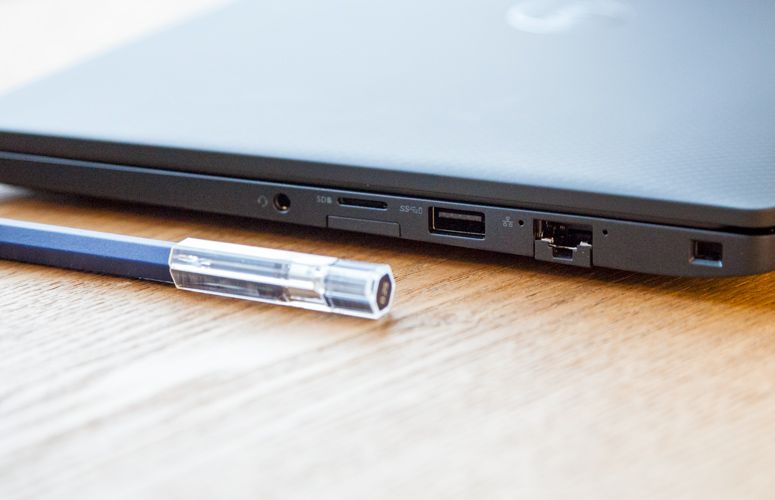
This is an unpopular opinion, but I think this proves that Apple was right to dump legacy ports. This solution is sort of clever but it sacrifices a ton of internal space that could have been spent on a bigger battery. USB-C, and the correct cables, are all anyone needs.
(the Nespresso analogy is ridiculous, a laptop doesn't exist to consume adapters. But I presume you were enjoying a little tongue-in-cheek with your coffee)