Per the embedded video (also used on the official site), they used textgenrnn (https://github.com/minimaxir/textgenrnn) to train the text-generating AI, which I made. Although I really wish they said that explicitly: not as a means of attribution, but to make the text generation more accessible/transparent which is why I made textgenrnn in the first place.
GPT-2 would likely have much more interesting results on such longer input text. If anyone from AKQA reads this, I'm open to help setting that up.
A lot of digital agencies claim they have AI/ML capabilities and are really just using others' tools. It's a shame they lacked the integrity to attribute you.
It's finding value in those tools which the agency (and most others, mine included) would be claiming to be capable of and I think to a reasonable extent they've proven that, even with a somewhat underwhelming result.
This isn't solving problems, it's riding the AI wave - and claiming the capability - while leveraging the work of others, without attribution. I mean they even use the damn program in their promotional video.
I'd be much more liable to support a "We AI and you can too!" than some cynical marketing activation.
Looks like they're using Keras to generate random phrases, then winnowing them down to the best few, which they extrapolate into a functional sport rulebook with their human brains.
Could have probably done this with a Markov chain as well. "apt-get install dadadodo" for instance.
Not terribly impressive when you phrase it like that. I can make a machine that shakes up a bunch of words. But then if I pick out the words to make a poem I haven't invented a poem-writing machine
This is why I am generally unimpressed with the state of AI. These techniques are great for things like recognizing images and text. I very much doubt it will be useful for any sort of intelligent action in the near future.
On the account, classical AI techniques like planning are more promising
It's not impressive. They didn't even build the tool, they just snagged the code from GitHub, said "This is AI!!!!" and without attributing it to the builder. It's cynical marketing ploy.
What does writing the algorithms have to do anything? Did you write the programming languages you use in your projects? Did you write the code behind your OS?
What about all those silly carpenters that don't forge their own hammers? How dare they! What fakes! Or doctors that don't create their own medicine?! The horror!
False equivalence. It's more like if I build a house based on someone else's plans, and then declare myself an architect.
AKQA is happy to make themselves sound smart in their video, when in fact all they did was run someone else's program, and without attribution. If that constitutes an AI practice then I'm in the wrong line of work - I should just be down at the city planning office photocopying other architects' plans.
That all depends how you use it. An OS? Definitely a tool, but it also has plans, blueprints, etc. for how to use them and build on them. Honestly, software is more like machinery- it's defined, more or less, by the inputs it receives, the outputs it creates, and the configuration tools that the machine has.
Some machines do very simple things, like turn a wheel and move a piston- but this very simple mechanism can be very valuable when it comes in the form of a twelve-ton press. Other machines are much more complicated, such as NC or CNC machines, which take a multitude of inputs and turn them into one output. Looking at the repository in question here, this one thing, built on Python (a specification for how to put machines together) is more or less its own little factory- it can take raw inputs, and spit out a usable, finished product.
To me,
textgenrnn
what nVidia seems to have done here is borrow an entire factory, feed it some materials, and do some finishing afterwards. From a manufacturing perspective, that's totally fine- but generally the company that does the work in the middle gets paid, and given that this is a free repository that I doubt nVidia donated to, it would, at the very least, be nice to see minimaxr get some credit for his work.
I was wondering about that as well, formatting a dataset of "rules" in a form ready to be digested by a NN seems like a very tricky problem. But then if they didn't actually teach the NN about the meaning of the rules but only how to generate strings of characters that looked like rules then it's a whole lot less impressive.
Nvidia has shown many interesting AI-related projects lately but this particular one reeks of marketing fluff without much substance to me.
Looking over the rules, it looks like there's an assumed "causal"-ness to the game (not good, not bad, just noting there's an assumption that everyone will play by the rules at all times). Based on the rules [1], there doesn't seem to be any consequence to fouling if you do not have the ball. What stops a non-carrying team player from stepping in the center or tackling a player?
Given the current ruleset, nothing. Three fouls give you a demerit, three demerits give you a reprimand, 3 reprimands ... to infinity. Secondly, is there a difference in severity to stepping in the center vs. tackling?
I get that you could say that 2 fouls is a timeout, and certain rules carry higher penalties (1 for center stepping, 2 for tackling), but it is not written.
Right. And kicking a rugby ball at full strength from a short distance towards an unprotected goalie might hurt. In the video they're only lightly passing and kicking the ball.
Being hit in the face (or genitalia) by a spherical football hurts a lot if the shooter knows how to shoot and you're relatively close. I don't want to imagine what it feels like to be hit by an ovoid ball.
How else would you score? In practice you don't kick the ball at players in football (soccer) or kick/throw it at them in rugby because you might give away possession; but it's a tactic in hardball games like baseball and cricket AIUI.
I've only trained as a referee in one sport and it had a "be a sportsman" element to the rules giving the ref leeway to determine that play is unbecoming of the sport and so give away a foul. But in that sport smashing the ball _at_ players is normal.
Sure, if you're playing with pals, or for a promotional video then you're going to be less combatative.
FWIW the rules don't say you can't knee, pull, or poke (eg in the eye!).
Also, the penalty rule sounds impossible - you have to score "from the centre gate", but being in the centre gate is a foul and gives possession to the opposing team ... ah, no, wait: "Moving through the center gate will result in a foul." ... so it's fine, you just aren't allowed to leave the centre gate [does the foul activate from the time of entry or the time of exit?].
>In practice you don't kick the ball at players in football (soccer)
Yes you do, just not intentionally. It is common for a player to shoot near the goal line in two ways: excellent placement with just the required strength, or a powerful shot.
"kick at" implicitly includes intent IMO. You kick the ball and it hits players, but rarely do you intend that as it is often counter productive (not hitting the goal, not making a pass; giving up possession).
The penalty kick is probably considered an exception.
> I've only trained as a referee in one sport and it had a "be a sportsman" element to the rules giving the ref leeway to determine that play is unbecoming of the sport and so give away a foul.
Curiously, the NFL--which has the single most pointlessly longwinded and legalistic rule book in probably all of sports--has a similar rule allowing referees to do literally anything at their individual discretion in response to any "palpably unfair" action or situation.
I think these are more like the basic rules of the game, rather than an official league rulebook. Like any other sport, additional rules would be needed for organized play, and those could vary from league to league.
For example, no one will eject me from the court if I commit too many fouls during a pickup game of basketball at the park, but the NBA, NCAA, FIBA, etc. each have their own rules regarding fouls and their associated penalties. League rules also evolve over time, sometimes in response to rule abuse.
So I wouldn't hold it against the game if the first iteration of the rules don't account for every aspect of competitive play. What's more important is whether the game is actually fun or not, and then leagues can evolve from there.
When people first look at ways to cheat in a team sport, I would argue that using them for target practice (in a ball sport that is) is a suitable lesson.
For less evil geniuses, I bet we can rely on social moderation to find appropriate punishments that make fouling just undesirable enough while they keep the spirit of the sport (in this case probably an electronic sheep) alive.
> When people first look at ways to cheat in a team sport, I would argue that using them for target practice (in a ball sport that is) is a suitable lesson.
While that will happen, as I said, as the rules exist now, house rules and social moderation are needed. If this were to graduate to "league play", then those types of penalties would need to be made as I'd argue its more difficult to enforce "target practice" against competition (or that you're only fueling the "there aren't enough rules" problem).
I am just trying to say that "exploiting" team sports usually has much more direct consequences than the equivalent in purely intellectual sports like IT. Thus, what's a loophole for a hacker who reads the rules, is just a raised eyebrow for a competitor or a fan in team sports. Smugness does not have a place in something based on fairness.
Baseball and to a lesser extent hockey are notorious for "unwritten rules" and nominally-disallowed enforcement of those rules by targeted acts of player-on-player violence.
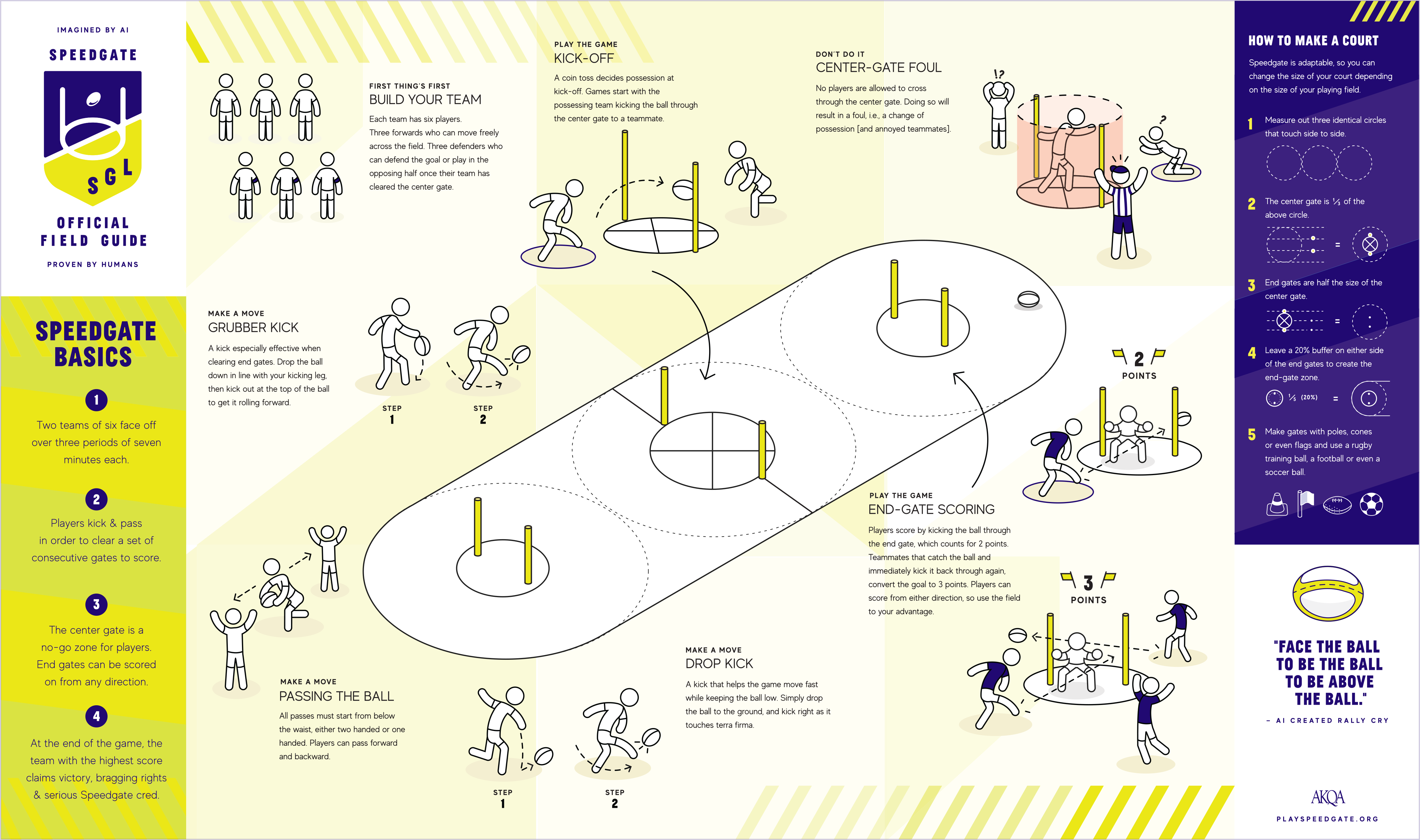
The article says that the AI generated 1k candidates which were then reviewed by humans which then selected 3 which seemed most promising and then massaged them into the final rules. Makes the "AI" part of the project look much less impressive if it took so much human input afterwards.
Perhaps a better use of AI would be to flesh out a comprehensive rulebook for playing 43-man Squamish. Someone needs to figure out what the Probate Judge & Baggage Smasher are supposed to do if it rains...
I'm not entirely sure what the restrictions on the defenders are (other than having to return to their half after their team scores), but there's an exploit I can see already:
> Only 1 defender is allowed in the end-gate circle at any time.
This says "defender", which is a role. So forwards would be allowed to bolster the gate's defense, which might make sense given the possession mechanic.
The lack of tackling and rules about passing direction, with body blocking allowed, means that huddling a few players together and creeping up might be a viable strategy that the defending team can't really counter. It would be a valid strategy in Rugby too (where you're only allowed to tackle the ball carrier), were it not for rules against obstructing tacklers.
This kind of turtling strategy seems contrary to the nature of the game, so if effective it would need nerfing/banning.
I think it's an ambiguous sentence with two possible interpretations:
> Only 1 defender, [but any other player] is allowed in the end-gate circle at any time.
> Only 1 defender, [and no other player] is allowed in the end-gate circle at any time.
I agree that it could use a clarification, but I think as you've noted the first interpretation doesn't make much sense in the game. If I were a referee of this sport, I would certainly interpret the rules as the second sentence.
So, if any forward entered the circle at any time, I would penalize them for that. I would use the fact that the rules that that only defenders are allowed in the end-gate, which implies that forwards are not allowed.
Well the ambiguity is "defender" meaning "a player on the defending team" and "a player with the role defender".
Actually the second interpretation could have an interesting effect, since it also doesn't specify team. So if the attacking team puts one of their defenders in the circle the defending team is out of luck.
What I couldn't quite grasp from the rules is how the center-gate works. Do you have to pass or kick the ball through the center gate to get to the other side or are you allowed to go around the center gate? Also, does the ball have to be kicked through the end gates on the ground or can you punt it right over? Seems like it might be hard to judge whether a goal was made since you can come at it from so many angles, if you're allowed to kick as high as you want.
Reminds me more of Aussie Rules Football than Rugby, to be honest, but sans tackling.
"For the center gate, you only have to clear it to unlock scoring, looks like then you can ignore it (other than not stepping through it)"
I believe you can see that idea in pick-up basketball when you only have one hoop; the opposing team who steals a ball must "clear" the ball by taking it back to some line (like the half-court line) before attempting to score, simulating a full court. In this case it is "intended" [1] to prevent you from just grabbing the ball from a scoring team and scoring immediately yourself. It adds some momentum to the game, otherwise it's rather unstable.
[1]: Or, if you prefer, "without this rule Speedgate would have been much less likely to survive the winnowing process and thus been found evolutionarily unfit".
I found the rules a bit unclear about this, but I don't think you can score on any gate. It talks about scoring on end "gates", but it also says your team's three defenders can only travel to the offensive side of the field once you've cleared the end gate, which implies that you're trying to score on only one end gate.
Shouldn't the center gate have a top crossbar on it then, like an association football goal? Unless you're going to have a lineman at each side looking across the tips of the poles, it's going to be hard to judge if the ball goes through or over.
They picked rules from almost all kinds of sports in the world but did they have that kind of diversity in the 'human fine tuning' piece of it? Otherwise I guess the end result is going to be bit biased.
> trained a recurrent neural network and a deep convolutional generative adversarial network on over 400 sports with the aim of creating a new and original sport.
Did they share anywhere what their training data looked like?
At 32 seconds into the video, you can see a few frames of a Google Sheet where one column is the name of the sport (you can see "Quidditch" quite a few times) and a second column is a rule, like "The Chasers are there to try and keep posession of the Quaffle...". Looks like one row per rule. Teh filename is "AKQA AI SPORT".
No idea if that's what they used for the actual training, though.
Yet another "look what we did with AI" hype piece where all they did was hand pick some output and mash it together to make something intelligible. Silly nonsense.
Would have been more interesting if they’d also used an AI to play each game and see how that turns out. Does the game have a simple always-win strategy? If so that games is gonna be pretty dull to play and watch.
there seems to be no analysis on why the size and dimension of the ball is chosen - very few games have balls that are not spherical.. seems too much human intervention in generating the Sport
This doesn't seem particularly viable as a 'sport', i.e. an athletic competition, but maybe fun as a group activity. e.g. You have 3 defenders that seem to be allowed to camp without restriction a 6' tall, 10' wide 'goal'. Put 3 athletes on this duty and no one will ever score.
The ricochet turns a goal from 2 points into 3. Seems like an extreme amount of difficulty to return kick an oblong ball in the air through the gates for only 1 point.
Yes, it was learned by PAGAN purely-automated GAN. It can form new music by learning rules from existing music and altering them in a symbiotic manner which pleases human ear. And of course some fine tuning by humans.
the gates are nets.
It's not really that different.
You pass the same, they even name the kicks the same (grubber, and drop kick) and it uses a rugby ball.
> Computer science defines AI research as the study of "intelligent agents": any device that perceives its environment and takes actions that maximize its chance of successfully achieving its goals.[1]
yeah, but these days AI is applied to anything related to machine learning. most of current AI is supervised learning, which doesn't fit your description


GPT-2 would likely have much more interesting results on such longer input text. If anyone from AKQA reads this, I'm open to help setting that up.